


Renault Premium Cab Fridge Not Cooling? Check Power First
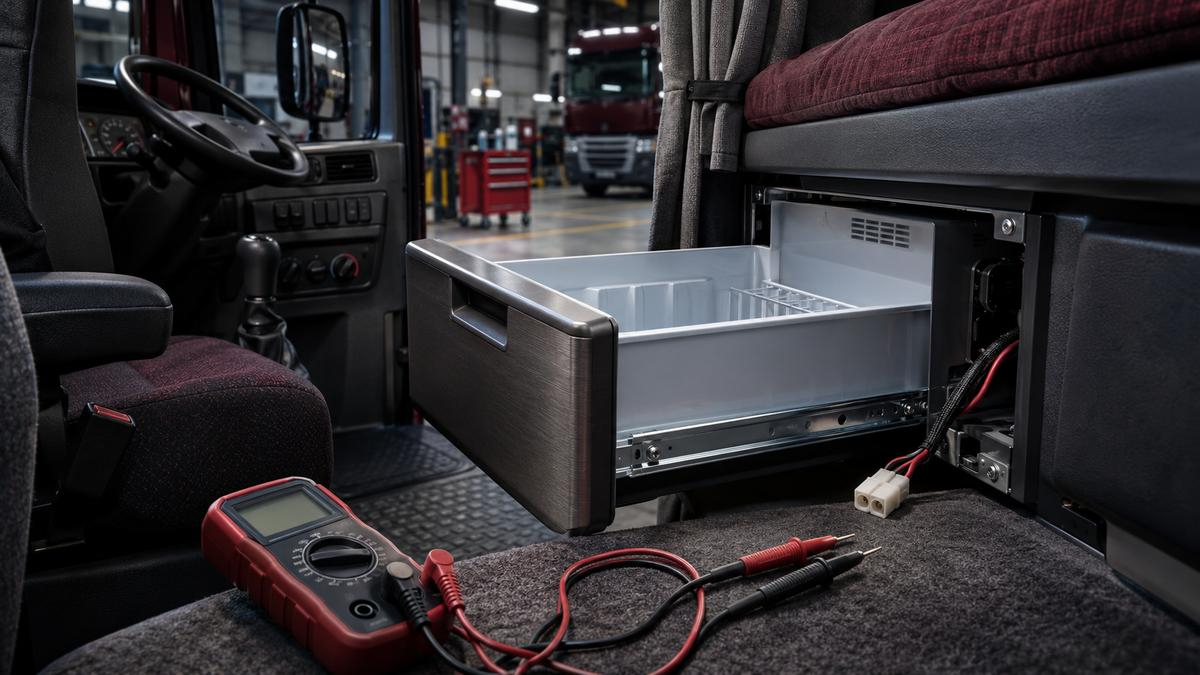
A cab refrigerator that runs intermittently, stays warm or stops altogether can disrupt a long-haul shift. It is tempting to order a complete replacement immediately, but a failed power supply, restricted airflow or poor drawer seal may produce similar symptoms. On a Renault Premium DXi, start by identifying the actual unit and recording the fault rather than assuming that every under-bunk fridge has the same electrical and mounting arrangement.
This guide uses a real VRA Truckparts listing for an Indel B drawer-style cab refrigerator, Renault reference 7420944918 (also shown as 20944918), as an identification example. The listing currently says not available for order; it is a reference for comparison, not an offer of available stock.
Identify the symptom before dismantling
Ask the driver whether the refrigerator is completely dead, starts and stops, makes its usual operating sound without cooling, or cools only while the engine is running. Note whether the problem began after electrical work, a flat battery, prolonged parking or a change in cab trim. These observations help distinguish a supply fault from a temperature-control or refrigeration fault. A running sound is not proof that the fridge is reaching a safe food-storage temperature.
Remove food if the compartment cannot maintain an appropriate temperature. Do not use uncertain cooling performance to store perishable food or medication. The first objective is a safe diagnosis, not an improvised repair of the sealed refrigeration circuit.
Check the electrical supply safely
Fuse, connector and voltage at the unit
With the vehicle safely parked, ignition and auxiliary systems in the condition specified by the truck manufacturer, identify the fridge circuit and its fuse from the correct wiring diagram. Look for obvious damage to accessible connectors, loose pins, moisture, heat discolouration or rubbed insulation. A fuse that blows repeatedly indicates a fault requiring investigation; fitting a larger fuse is not an acceptable cure.
A competent technician can measure supply and earth at the fridge connector and, where the approved procedure allows, assess voltage under operating load. A healthy battery reading at the cab does not establish that the appliance is receiving adequate voltage: resistance in a connector, earth point or harness may cause a drop at the unit. Do not assume the required voltage or polarity from the vehicle alone; use the refrigerator label and model-specific documentation.
HSE's workplace-vehicle maintenance guidance stresses safe isolation, trained staff and avoiding battery short circuits. Use the manufacturer's electrical procedure before unplugging or removing powered equipment. Never probe unknown terminals, bypass protective devices or modify wiring to make a second-hand fridge work.
Why intermittent cooling is not automatically a bad compressor
Some vehicle refrigerators have battery-protection behaviour that prevents excessive discharge. Such systems vary by model, so do not assign a particular low-voltage threshold to this Renault unit without its service information. Also check whether a timer, auxiliary battery or cab management setting changes the fridge supply with the engine stopped. These are diagnostic possibilities, not confirmed faults on any particular truck.
Airflow, drawer and seal checks
Inspect the installation area for dust, loose insulation, luggage or trim blocking ventilation around the refrigeration equipment. Compare actual clearances with the correct appliance instructions before refitting. Other Indel B commercial-vehicle fridges show that compact under-bunk layouts, compressor assemblies and drawer arrangements vary, so a photograph of a superficially similar model cannot establish installation clearances for this one.
Check that the drawer closes squarely and the gasket contacts the mating surface all the way round. Dirt, a distorted front panel, misaligned rails or a trapped item can admit warm air. Clean accessible surfaces with an appliance-safe method and inspect the lining for cracks, without dismantling refrigerant pipework. If the fan, control electronics or cooling circuit is suspected, refer the unit to a suitably qualified technician.
What the VRA example actually establishes
The VRA Renault Premium DXi cab refrigerator listing describes a used, complete drawer assembly with wiring and a two-pin connector. Its published label details include 30 litres, 12/24V DC, 42W and R134a refrigerant, 40g. The seller reports a basic operational check before dismantling, while the condition notes acknowledge cosmetic wear. That report is not a current independent performance or temperature test.
The heading also mentions DAF CF, and the page lists other vehicle references. Neither wording alone proves universal interchangeability across Renault and DAF cab generations. If your unit has a different label, controller, connector, mounting arrangement or drawer geometry, do not infer that the two assemblies are substitutes. In particular, a 12/24V rating does not prove that every vehicle harness, fuse or control strategy matches.
Inspecting a used replacement before purchase
Request a clear photograph of the label on your failed unit and compare it with the candidate's full number, including prefixes and suffixes. Record cab model, production details, VIN, mounting location, plug orientation and the dimensions of the surrounding cabinet. Then examine actual-item photographs for broken fixing tabs, bent rails, drawer movement, gasket condition, signs of water damage and any cut or repaired wiring. Confirm what mounting hardware is included rather than assuming that brackets and fasteners arrive with the assembly.
VRA's compatibility and VIN guidance explains why the OEM number and photographs must be considered alongside vehicle information. Its parts-ordering guide also sets out which identifying details and images buyers should prepare. Check the live product status before planning a repair: the cited example is currently marked unavailable for order, and used inventory can change.
Professional fitting and the practical decision
Before installation, correct any confirmed vehicle-side electrical problem. Fit only a unit identified as suitable for the truck, follow its mounting and ventilation instructions, secure the wiring against abrasion and verify the electrical supply with the correct protection. Refrigerant handling and sealed-system repairs belong with trained, appropriately equipped professionals; do not vent refrigerant, cut tubing or attempt to recharge the unit as a trial-and-error diagnostic step.
Once the installation is complete, document stable operation and temperature performance under normal cab conditions, allowing adequate time for the compartment to cool. Record the original and replacement part references in the vehicle's maintenance file. The practical takeaway is simple: prove the supply, airflow, closure and exact part identity before condemning the fridge. A careful check can prevent replacing a perfectly serviceable assembly while leaving the actual fault in the truck.
Help other users with the choice - be the first to share your opinion about this post.