

Why Used OEM Truck Parts Beat Cheap Aftermarket for MAN, DAF, Volvo and Mercedes-Benz Fleets
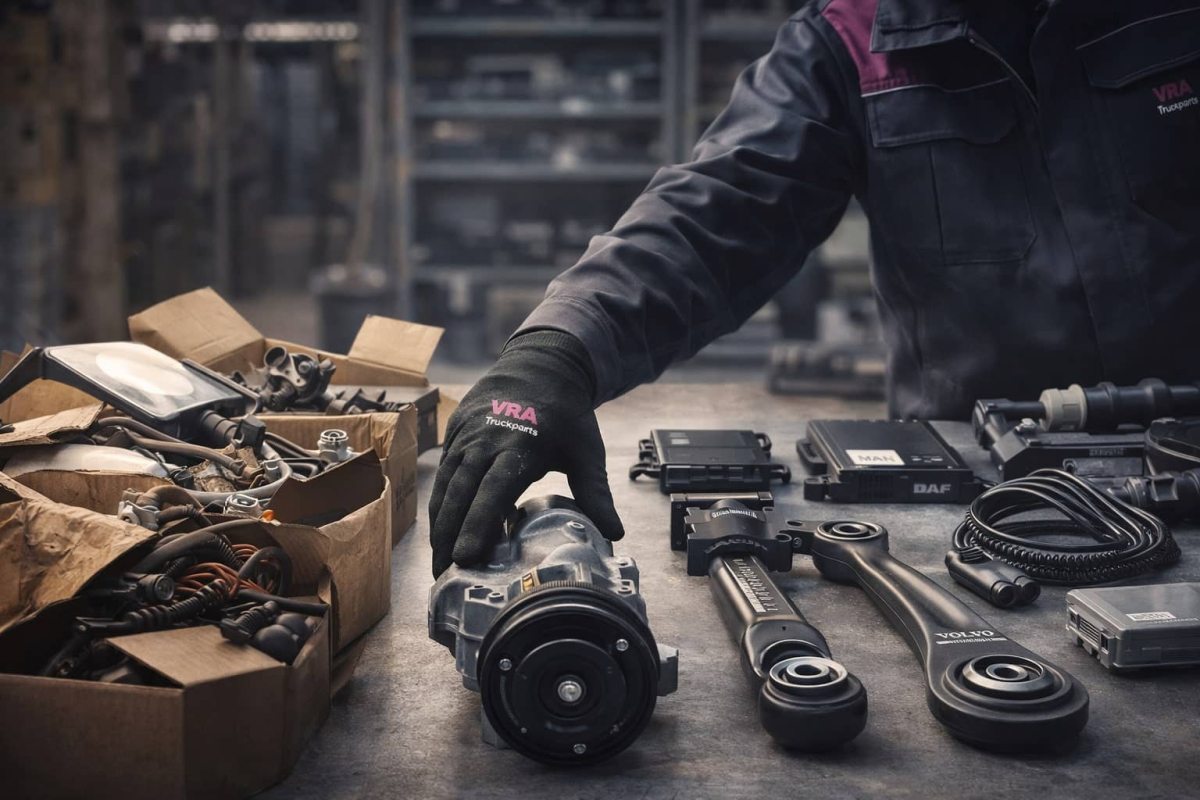
Running a modern European truck fleet is a constant balance between uptime, safety and cost-per-kilometre. When a vehicle is down, the temptation is to grab the cheapest part you can find and get it back on the road. But for MAN, DAF, Volvo and Mercedes-Benz trucks, the smartest choice is very often used OEM parts from a professional dismantler, not the cheapest new aftermarket component.
In this article we’ll unpack why that is – and how working with a specialist like VRA Truckparts helps you protect your trucks, your drivers and your repair budget.
1. OEM means correct fit, calibration and performance
Original Equipment Manufacturer parts are built to:
- match the exact dimensions, materials and tolerances specified by the truck maker;
- integrate cleanly with factory wiring, ECUs and safety systems;
- withstand the loads and duty cycles that a 40-tonne combination sees every single day.
Cheap pattern parts may look similar at a glance, but small differences in casting quality, bush hardness, wiring or connector sealing can lead to:
- premature wear (e.g. in suspension arms, cab mounts, steering joints);
- electrical problems and nuisance fault codes;
- poor fit that stresses surrounding components.
Industry buying guides for used DAF XF, MAN TGX, Volvo FH and Mercedes-Benz Actros all highlight issues such as hub seals, air tanks, NOx sensors, wiring looms and ECUs as common failure points. Choosing proven OEM components greatly reduces the risk of fitting a part that makes those issues worse.
When you buy used OEM, you’re getting the exact part the vehicle was designed around – just with a previous life.
2. Used OEM vs new aftermarket: the real cost
On paper, new aftermarket parts can look attractive: “brand-new”, low price, quick to ship. But if that component:
- fails early,
- never quite fits correctly, or
- causes an MOT failure or a roadside breakdown,
then the true cost (recovery, workshop time, lost load, driver hours) will dwarf the saving on the invoice.
By contrast, a high-quality used OEM part from a relatively young donor truck often offers:
- longer remaining life than an unproven budget component;
- known behaviour – fleets and workshops understand how the genuine part performs;
- predictable compatibility with other factory systems (especially with Euro 6 emissions, AEBS, ACC and ECAS).
Think of it as buying a well-maintained, low-mileage tractor unit rather than a brand-new but unproven prototype.
3. Why professional dismantling matters
Not all “breakers” are equal. A structured dismantling process is what turns a dead truck into reliable stock:
- Careful donor selection
- Late-generation MAN TGX/TGS, DAF XF106, Volvo FH/FM and Mercedes-Benz Actros, primarily Euro 6.
- Preference for vehicles with known history (fleet trucks with records), not mystery salvage.
- System checks before strip-down
- Starting engine and drivetrain where possible.
- Scanning ECUs for stored fault codes.
- Checking functions like ACC, AEBS, ECAS, lighting and cab electrics.
- Clean removal and labelling
- Components removed with wiring, brackets and fixings where feasible, not cut with torches.
- OEM numbers, revision codes and positions recorded.
- Inspection & testing
- Visual inspection for cracks, corrosion, worn splines, bent brackets.
- Functional testing for moving parts and electronics where practical.
- Cleaning, storage and photography
- Parts cleaned so defects are visible.
- Shelved in dry racking, away from weather and accidental damage.
- Multiple high-resolution photos taken for online listings.
That process is what VRA Truckparts is built around – so when you see a part listed as tested OEM, it has already passed several gates before it ever reaches the website shelf.
4. Brand-specific examples
MAN (TGX / TGS)
Used MAN buying guides point out that cooling and EGR components on certain D26 engines, along with air system parts, deserve close attention.
A professional breaker will:
- pressure-test coolant-related parts where possible;
- inspect air tanks, valves and ECAS components for corrosion;
- clearly list part numbers and any MAN supersessions.
DAF (XF 105 / XF 106)
For DAF XF, common wear areas include hub seals, brake discs, NOx sensors and modulator valves.
Quality used OEM parts mean:
- genuine hubs and brake components with known metallurgy;
- original DAF-spec NOx sensors and AdBlue hardware that talk correctly to the ECU;
- cab and chassis components that line up with factory mounting points.
Volvo (FH / FH4 / FM)
Volvo FH and FM trucks frequently show age in seals, electrics, door components and AdBlue systems.
Used OEM parts from Volvo donor vehicles can provide:
- factory-spec wiring looms and control units with correct software baseline;
- cabs parts that match interior colours and trim codes;
- original suspension and steering components built for Volvo’s geometry.
Mercedes-Benz (Actros MP3 / MP4)
Actros buying guides often mention water ingress into wiring looms and ECUs, as well as issues with certain AdBlue and ACM modules.
A dismantler that understands these weaknesses will:
- visually and electronically test ECUs and modules;
- inspect housings for corrosion and moisture marks;
- avoid selling components from trucks with known flood or loom damage.
5. Sustainability: saving money and the planet
Under EU and UK end-of-life vehicle rules, vehicles are expected to achieve around 95% recovery and 85% recycling by weight.
Buying used OEM parts supports that circular economy:
- every reused axle, cab door or ECU avoids energy-intensive production of a new one;
- fewer materials go to landfill or low-grade recycling;
- your fleet’s environmental footprint per kilometre drops without changing the truck.
For customers tendering for contracts where sustainability matters, being able to say that you use recycled OEM parts from a certified dismantler is a quiet but powerful advantage.
6. Why fleets choose specialists like VRA Truckparts
For UK and EU operators running MAN, DAF, Volvo and Mercedes-Benz trucks, a partner like VRA Truckparts offers:
- Large stock of dismantled OEM components from popular Euro 6 tractors and rigids.
- Clear OEM numbers, multiple photos and honest descriptions of condition.
- Tested parts wherever possible, especially for electronics and safety-critical components.
- Fast UK and international shipping, palletised for bulky items.
Used OEM is not a compromise – it’s often the most intelligent choice for keeping your fleet safe, compliant and profitable.
Help other users with the choice - be the first to share your opinion about this post.